

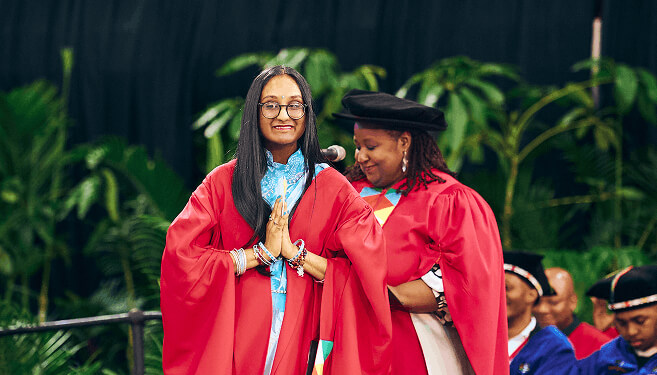
Economics lecturer, Dr Priyanka Harrichurran, has graduated with a Doctor of Philosophy in Economics having concluded a novel study titled: ‘Time poverty in South Africa: A gendered analysis’.
Time poverty occurs when people have little or no time to rest and recuperate in a day after completing their work tasks and their “unpaid labour”, such as household chores and childcare.
Harrichurran’s research was supervised by Professor Claire Vermaak and Professor Colette Muller.
Her thesis develops a gender-sensitive approach to measuring time poverty and shows that women experience higher rates of time poverty than men when their employment status and household structure are considered. African women who have paid employment and live with their partners in extended households were identified as particularly vulnerable.
Harrichurran said that traditional poverty measures overlooked the ultimate scarce resource – time – which was essential for overall well-being and because time poverty was measured at the individual level, unlike traditional metrics such as income poverty, it uncovered hidden gender and household inequalities that would otherwise remain invisible.
“The findings have implications for gender inequality, well-being, and productivity, inform policies promoting a more equitable division of paid and unpaid labour, enrich poverty alleviation programmes, and shed light on time constraints that restrict non-employed women’s labour market participation,” she said.
Harrichurran received the National Research Foundation Doctoral Scholarship and the UKZN College of Law and Management Studies Doctoral Scholarship for her PhD.
Sharing her doctoral research across prominent local and international platforms was a career highlight for Harrichurran. She presented her work at the Oxford Centre for the Study of African Economies (CSAE) Conference in England, the 47th International Association for Time Use Research (IATUR) Conference held in Johannesburg, the 31st, 32nd, and 33rd International Association for Feminist Economics (IAFFE) Conferences held in Cape Town, Italy and virtually, respectively, the University of Maryland Time Use Conference (online), the Economics Society of South Africa (ESSA) Centenary Conference held in Somerset West, and the ESSA National PhD Conference held in East London.
“Presenting on these platforms helped me to refine my research through peer and expert feedback while bringing South Africa’s hidden time poverty crisis into vital international scholarly and policy conversations,” Harrichurran said.
Harrichurran attributes her success to those who supported her. “I am deeply gratefully to my supervisors for their constructive feedback and mentorship. I see this doctorate not just as an individual success, but as a reflection of the collective strength, unwavering support, and shared sacrifices of my parents. I am also grateful to my Guru, God, family, friends, colleagues, students, and well-wishers who stood by my side to make this achievement possible. Thank you, from the bottom of my heart, to everyone who played a role in my PhD journey – I see you and I appreciate you!” she said.
Harrichurran is now the principal investigator of a new research project investigating whether artificial intelligence usage saves time for staff and students in Higher Education Institutions in South Africa. This project, which is currently in the data-collection phase on LinkedIn, was awarded a research grant by the College of Law and Management Studies Dean of Research, Professor Phocenah Nyatanga and College Deputy Vice-Chancellor and Head, Professor Ernest Khalema.
Looking ahead, Harrichurran sees the qualification as a springboard for deeper scholarly impact.
“Having a doctoral qualification gives my voice as a researcher greater weight and opens doors to early-career academic opportunities, such as leading research projects, securing grants, and supervising doctoral students. Beyond marking a key milestone for career growth, the doctorate builds my credibility and capacity as an academic, strengthening my ability to contribute meaningfully to both teaching and research,” she said.
Words: Thandiwe Jumo
Photograph: Sethu Dlamini